
Chrisevolve
← back to work
Togal AI · 2020—2021

The first AI
takeoff tool.

Construction estimators were drowning in manual takeoffs. We shipped an AI that found the rooms, doors, and windows in their drawings — and earned their trust by showing every pixel of its work.

RoleLead Product Designer
TeamSolo design · 4 ML · 3 FE · 1 Head of Product
Timeline12 months · 2020 – 2021
StackFigma · React · GitHub
scroll · the case
01
The problem

Estimators were drowning
in their most important task.

A takeoff is the act of counting and measuring every door, window, wall, and room across hundreds of construction drawings — so an estimator can price a bid. It is the first thing that happens on a project, the last one to finish, and the one most prone to error. Miss a bathroom on page 47, and the entire bid is wrong.

What was broken

A 40-hour count, in a 4-week bid window.

A senior estimator on a mid-size commercial bid spent 30–50 hours per project clicking on rooms and doors in Bluebeam — the entire weekend, then most of Monday and Tuesday — before they could even start pricing.

Why it mattered

The cost of a wrong number is the whole project.

Bid too low — you build at a loss. Bid too high — you lose the job. A single missed bathroom on page 47 cost one of our customers a 6-figure margin. Speed and accuracy weren’t a feature — they were the product.

02
Process

I worked the trade
before I worked the screen.

No personas, no whiteboard frameworks, no opinion-led redesign. I rode shotgun with six estimators across three GC firms for a week, traced a single winning bid backwards keystroke-by-keystroke, then co-sketched the fix on tracing paper laid over their own drawings. The screen came last.

Move 01

Ride-along — a week on the estimator's desk

Six estimators, three commercial GCs, real bids on the clock. I logged every interruption, every PDF re-open, every “hold on, let me re-check this room” moment. The pattern was sharper than any heuristic — trust got rebuilt from scratch every time the AI made a call.
Move 02

Bid-back trace — reverse-engineer one winning bid

Picked one bid that closed at $2.4M, sat with the lead estimator, walked it backwards: from the line item the GM signed off on, to the spreadsheet, to the takeoff, to the first time the PDF was opened. Marked every place trust was built, broken, or worked-around — 38 events in one bid.
Move 03

Co-sketch — design on top of their drawings

Brought tracing paper, markers, and three concepts back to the same six estimators. We sketched directly over the architectural PDFs they were already working on. They redlined two concepts to death; the third — confidence-as-color, override-in-place — they kept asking when they could have it.

Three frictions blocking adoption

01

Black-box AI

The model returned measurements with no visible confidence. Estimators couldn't tell what to trust without re-measuring everything by hand — which defeated the entire point.
02

No first-class drawing tools

When the AI got it wrong on a freeform shape, there was no graceful override. Estimators had to delete the AI's output and start with a blunt rectangle tool. The fix was more painful than the original mistake.
03

Cognitive overload at the canvas

Every layer, label, room name, color code and AI prediction stacked at once. New users opened the app and froze. Senior estimators learned to ignore most of it — including the AI's most useful signals.
Synthesis

From signals to design moves

Each friction got pressure-tested through the same loop: paper sketches → low-fi Figma → clickable prototype with 5 estimators → revise, or kill. Roughly half the ideas died here. What survived became three principles that everything in the redesign answers to.

What I heard
So I decided
Which showed up as
“I can't trust a number I didn't measure myself.” — 4 of 6 estimators
Confidence is a first-class citizen of the canvas, not a footnote.
shippedThree-tier color-coded trust layer. Green = trust, amber = verify, red = override.
“When the AI is wrong, fixing it is worse than starting from scratch.”
Treat the AI as a peer, not a boss. Override has to be one click — never a workflow restart.
shippedDrawing tools live beside the detection panel. Nudge a shape; don't redraw it.
“There's so much on screen I don't know where to look.” — every new user, week one
Default to calm. Reveal density on demand, not by default.
shippedProgressive disclosure: layers, labels and AI predictions surface only on hover or focus.
What I cut
A natural-language assistant (“ask the AI to find all bathrooms”), an autonomous “auto-bid” mode, and a confidence number shown as a percentage. Each tested well in demos and badly with real estimators — they wanted control, not magic, and the percentage gave the AI false authority. Killed in week 4.
Foundation

The system underneath the work.

A small, opinionated system: one display face, one workhorse sans, one mono for instrumentation. Two greens that carry every signal of trust — one for the everyday, one for the dark surfaces. Tokens, not decisions, all the way down.

↳ Palette
togal
#1AA84A
Primary · trust
togalDeep
#0D3A1F
Display · dark
ink
#15140F
Body · headlines
paper
#F3EFE8
Surface · paper
paperDeep
#F3F7EC
Tinted surface
warn
#C64A3A
Override · verify
↳ Typography
Aa Gg
Display · italic
DM Serif Display
Aa Gg
Body · UI
DM Sans
Aa 09
Tags · numerals
DM Mono
The numbers, post-launch

The bid gets out
before the
competitor’s does.

Three KPIs we set day-one and held to. None of them moved the way they did because the AI got smarter — they moved because estimators finally believed the numbers it returned.

Study window
90 days post-GA
Sample
37 firms · 412 bids
Method
Pre/post · in-app + interview
0×
01Faster than manual takeoff
Two-day spreadsheet ritual collapsed to ~10 minutes per commercial bid.
measured · n=412 bids
manual
16–24 h
with Togal
~10 min
+0pts
02Trust in AI output
Pre-launch 41 → post-launch 79. Biggest single-metric mover in the entire study.
7-pt scale · n=86 estimators
pre
41
post
79
0%
03Time-to-first-estimate
New users finish their first complete takeoff in under 30 minutes — no support, no hand-holding.
unmoderated · n=24 new users
v0
~107 min
v1
~30 min
What didn’t move
Win-rate on bids stayed flat at +2pts (within noise) — speed got bids out but didn’t change pricing strategy. We flagged it to leadership on day 60 and pulled the metric out of the launch deck. Rigor over narrative.
“Our backlog used to be three weeks. It’s two days now — and the bids are tighter, not sloppier.”
— VP Estimating
Top-100 commercial GC
Day 90 follow-up
03
What I shipped

An AI that
shows its work.

Rolled out behind a feature flag over 6 months — internal → 5 design partners → 25 firms → public beta. Three surfaces did the heaviest lifting; the rest fell out for free.
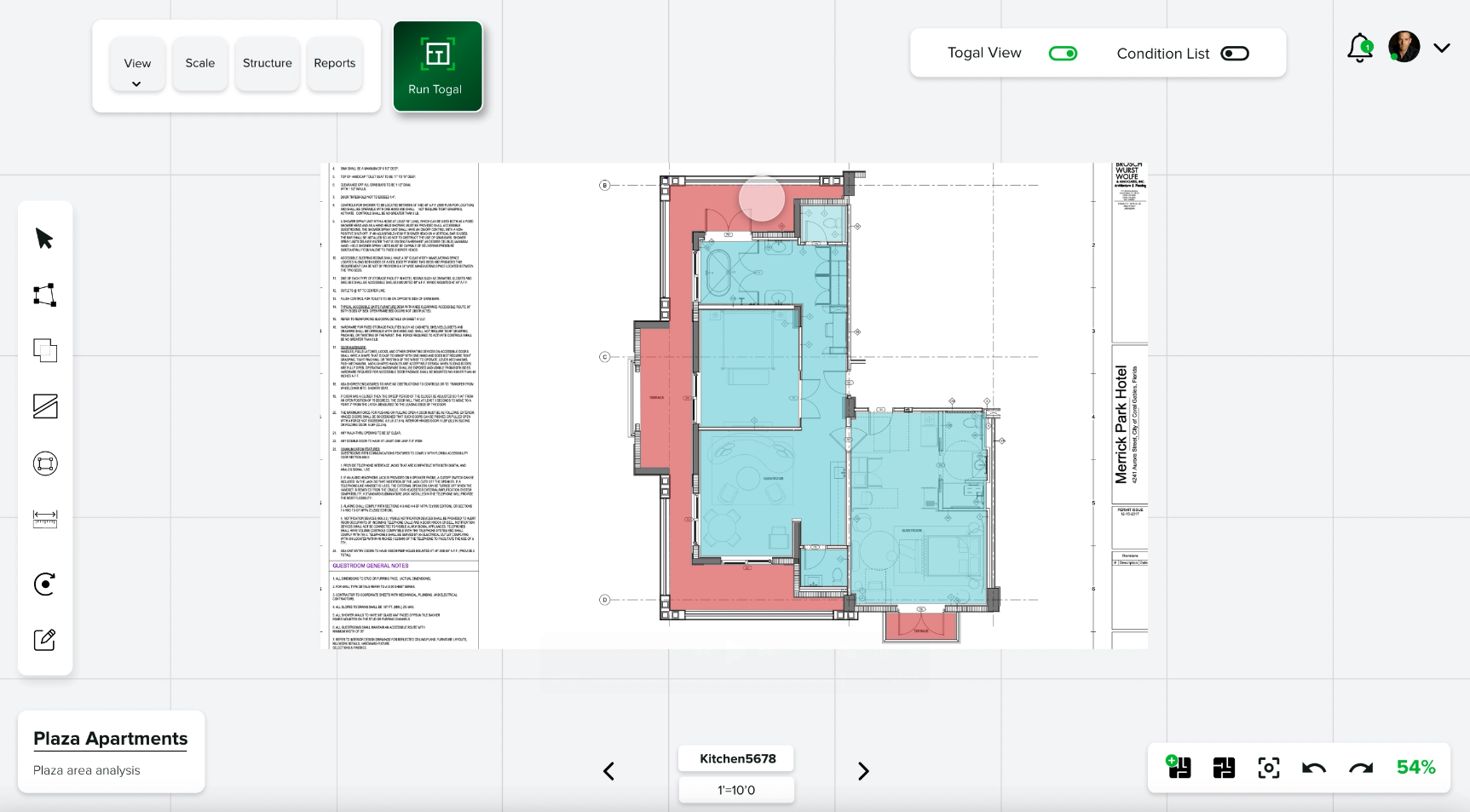
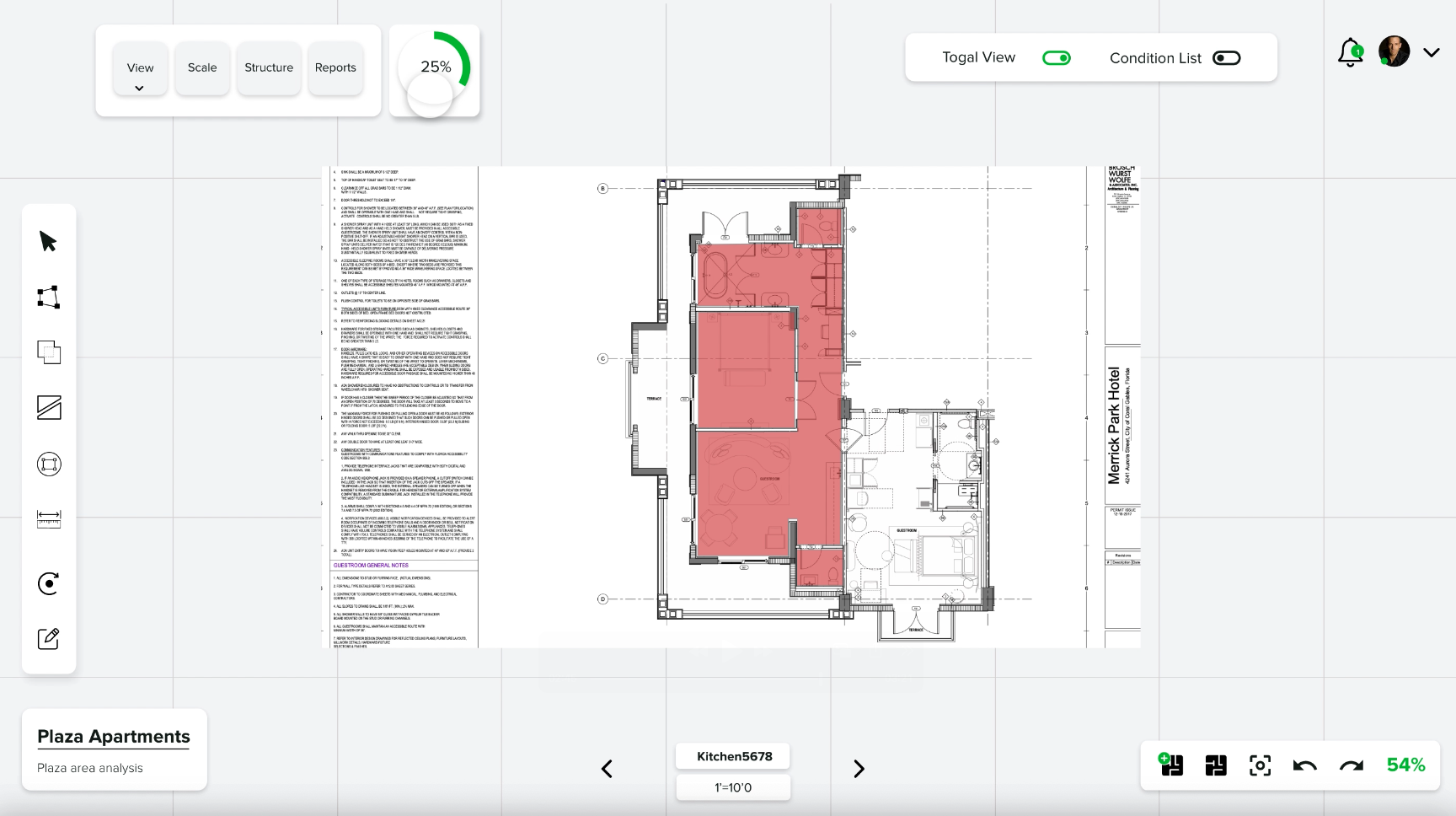
01 · Workspace
A canvas where the AI is a peer, not a black box
fig. 01 · annotated
Togal AI workspace with annotated AI-detected boundaries
ai · detecting
1
1 · confidence colors per area
2
2 · AI-detected boundaries
3
3 · layer trust panel
Override flow detail
02 · Override

First-class drawing tools beside the AI

When the AI gets a freeform shape wrong, the estimator nudges it instead of redoing it. Override is one click, not a workflow restart.

−4×
fewer clicks to fix a wrong AI shape vs. v0’s “delete + redraw” path
03 · End-to-end

The whole loop in under a minute

fig. 02 · 00:54
04 · Surrounding surfaces

The first and last screens of the day

fig. 03 · two-up

The workspace gets the headlines, but estimators live just as much in the bookends — the door they walk through every morning, and the gallery they triage their week from. Both inherit the same trust language as the canvas.
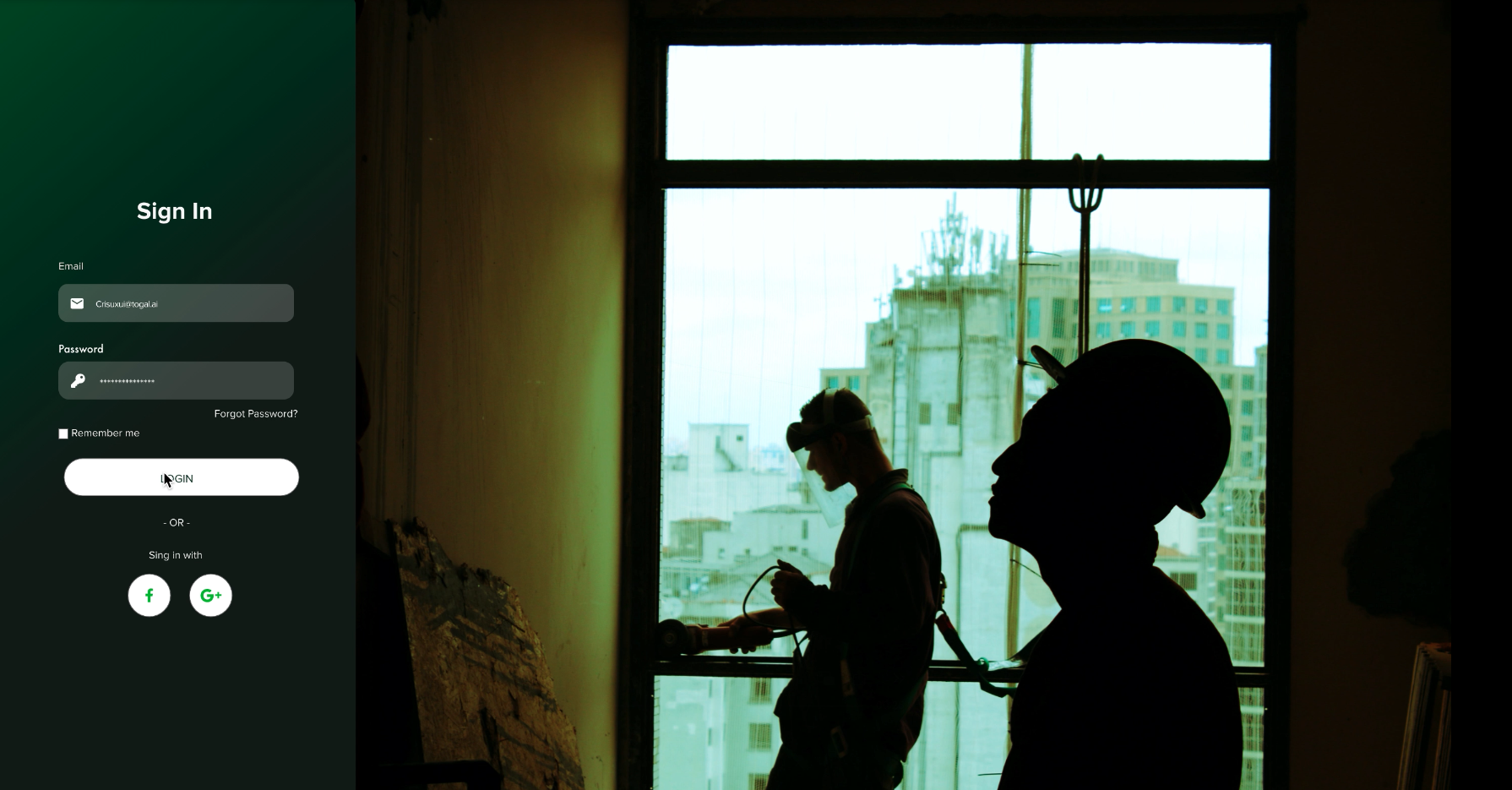
Togal AI sign-in screen
sign-in
A.
Sign-in · the front door
Cinematic full-bleed hero pulls construction back into a tool that lives inside it. Form chrome reduced to two fields and a green primary action — no marketing copy, no busy nav.
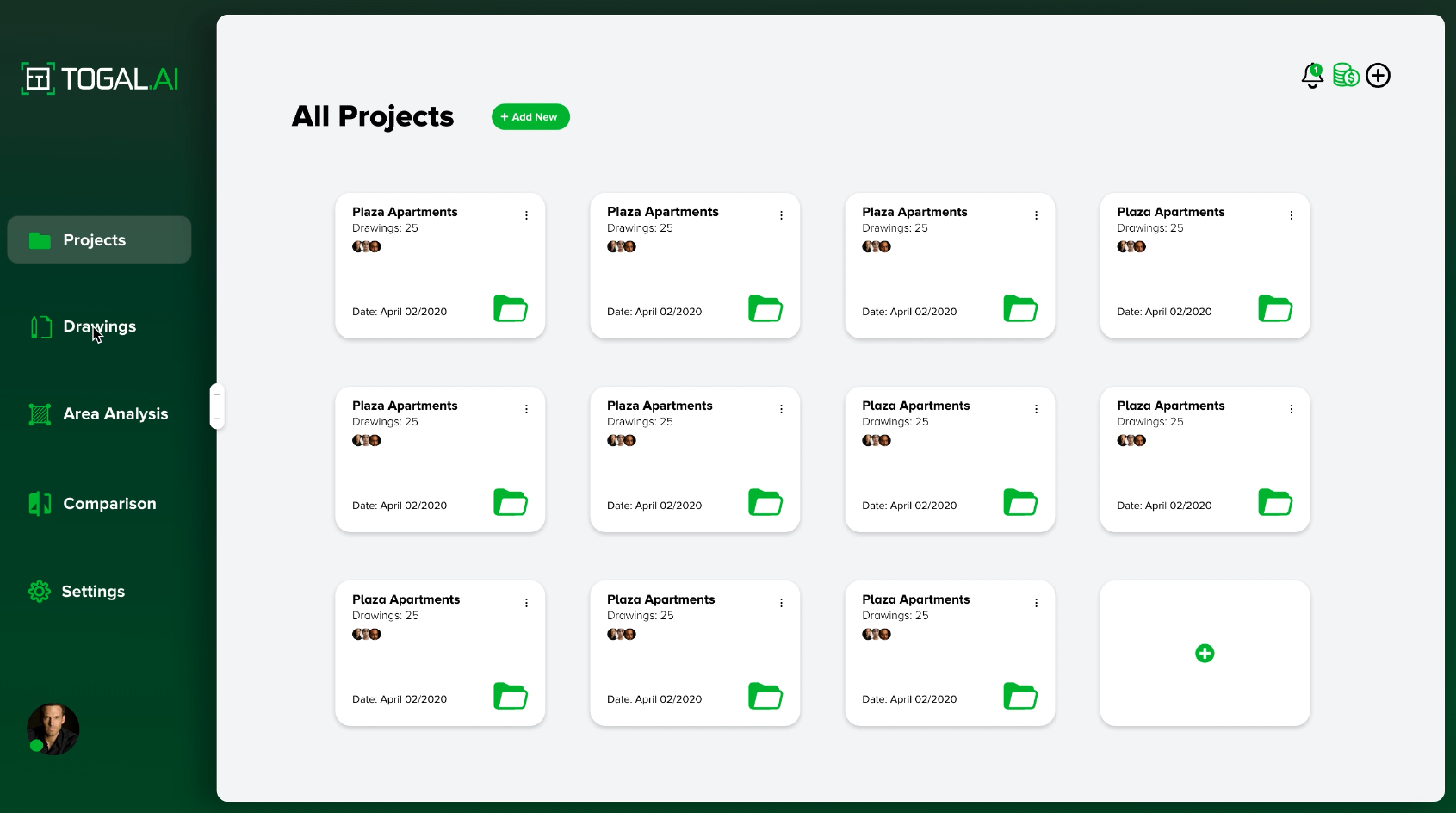
Togal AI projects gallery
projects · 11 active
B.
Projects · the daily triage
Same green ink as the canvas, same monospaced status type — so a folder card, a layer, and a confidence chip all read as the same system. Cards stay quiet so the Add new action can stay loud.
04
Reflection
“Designing for AI is mostly designing for the moment a user decides whether to believe it.”
— what I learned, in one sentence
What I’d do differently
  1. More cross-trade discovery. Optimized for commercial GC. Subs and residential users had a different model of trust we didn’t fully address.
  2. Confidence visualization, earlier. The color system landed late in the build. Had it been a constraint from week one, several screens would be simpler.
  3. A real handoff to Excel. We shipped CSV. What estimators wanted was a live, named-range XLSX dropping into existing pricing books.
05
Results & feedback

What moved,
and by how much.

10×
Faster than manual takeoff
2 days → ~10 min per commercial bid.
54→91%
Task completion on a complex plan
+37 pts. The hardest plans became the most reliable.
58 → 82
SUS score
+24 pts. First time the product crossed the “good” threshold.
−72%
Time-to-first-estimate
New users finish their first complete takeoff in <30 min, unassisted.
+38 pts
Trust in AI output
41 → 79. Biggest mover in the entire study.
−54%
Onboarding support tickets
Freed CS to focus on power-user questions instead of basics.
“First takeoff tool I’ve used where I trust the numbers without redoing them by hand.”
Senior Estimator · Mid-size GC · 18 yrs in the trade
↓ next case · PayCargo Platform · 2024—2026
Redesigning the
PayCargo payment flow. →